Acrylic Standee Size Guide: Standard Sizes & How to Choose
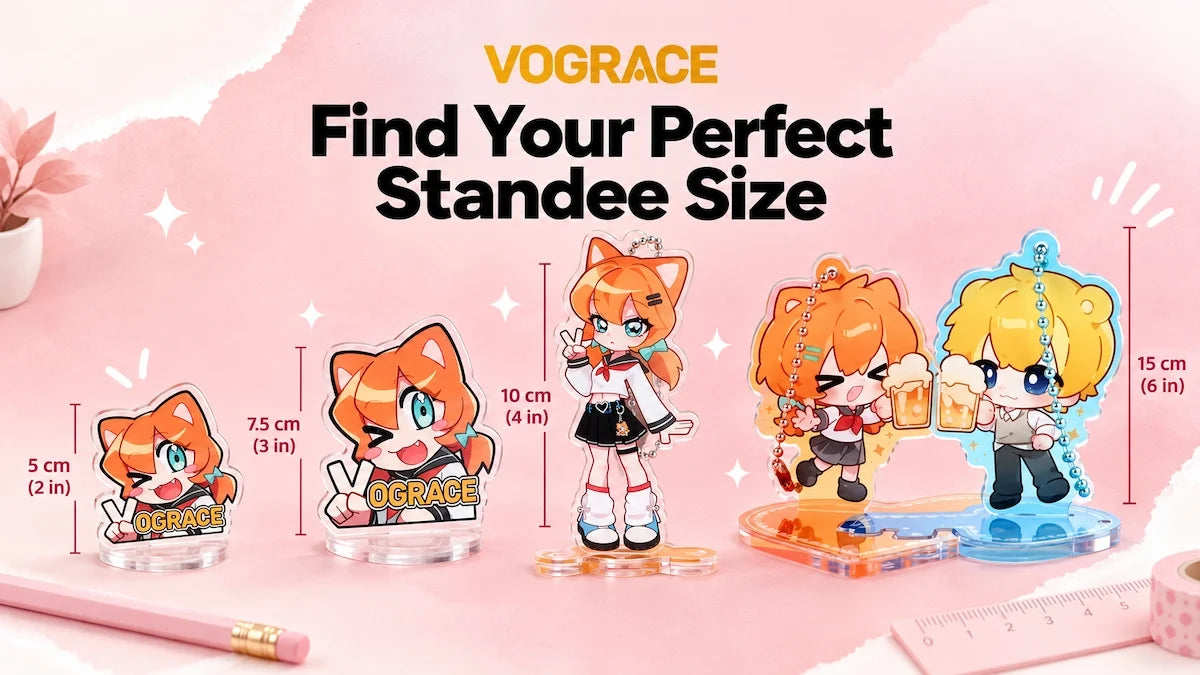
Choosing an acrylic standee size sounds simple until you put the same artwork at 2 inches, 4 inches, and 6 inches side by side. A design that feels charming and collectible at one size can look cramped at another—or take up far more desk space than expected.
For artists and merch creators, the right size comes down to more than height. Your artwork style, level of detail, display space, base proportions, budget, and the way customers will use the finished product all matter.
This guide covers the most common acrylic standee sizes and gives you a practical way to choose one that fits your design.
Standard Acrylic Standee Sizes
There is no single universal standard for acrylic standee dimensions. Custom manufacturers offer different size options, and the final shape can vary significantly from one artwork to another.
Still, most character standees fall into a few practical size ranges:
|
Size Category |
Approx. Size |
Best For |
|
Mini |
2–3 in / 5–8 cm |
Chibi characters, mini sets, giveaways |
|
Medium |
3–5 in / 8–13 cm |
Character merch, desk displays, Artist Alley |
|
Large |
5–7 in / 13–18 cm |
Detailed artwork, premium merch |
|
Extra Large |
7+ in / 18+ cm |
Statement pieces, large displays |
Across current custom standee suppliers, sizes around 8–12 cm (roughly 3–5 inches) are especially common for character merchandise, while 100 mm is frequently treated as a versatile desktop size.
For many artists, that medium range is the easiest place to start. It provides enough room for facial details, clothing, accessories, and clean silhouettes without making the finished standee feel oversized.
That does not mean medium is always better. A tiny chibi collection may work beautifully at 2.5 inches, while an elaborate full-body illustration can benefit from 5 or 6 inches.
The goal is not to find the biggest size. It is to find the size at which your artwork looks complete.

How Is Acrylic Standee Size Measured?
One of the easiest mistakes to make is assuming that standee size refers only to height.
For custom-shaped acrylic standees, manufacturers commonly calculate size using the longest side of the finished main piece. Depending on the artwork, that may be its height or its width.
At Vograce, the selected standee size is based on the longest edge of the artwork and includes the standee border—not only the printed illustration itself. The default border width is 2 mm.
For example:
If your finished cutline measures:
100 mm high × 62 mm wide
the longest side is 100 mm, so the standee is treated as a 100 mm size.
Now imagine a character holding a long sword horizontally:
90 mm high × 120 mm wide
Although the character itself is only 90 mm tall, the finished standee is 120 mm on its longest side.
This is why it is better to think in terms of the finished cutline, not simply the height of your character.
Hair, wings, weapons, tails, text, effects, props, and decorative backgrounds can all extend the silhouette and change the final dimensions.
Which Acrylic Standee Size Should You Choose?
There is no one-size-fits-all answer. Start with what the standee needs to do.
Is it a small collectible? A standard desk decoration? A convention product? A premium centerpiece?
Those questions usually narrow the size down quickly.

Small Standees: Compact and Easy to Collect
Small acrylic standees around 2–3 inches (5–8 cm) work especially well for simple designs.
They are a natural fit for chibi characters, mascots, simplified portraits, mini character sets, blind-box-style collections, and lower-priced merch.
Their biggest advantage is collectibility.
A customer can display several small characters together without needing much shelf space, making this size attractive for series with multiple characters or variants.
The tradeoff is detail.
Tiny facial features, fine linework, intricate clothing patterns, small text, and narrow accessories become harder to appreciate as the artwork shrinks. A design that looks perfectly readable on your monitor may feel much busier once it is only a few inches tall.
For small standees, strong silhouettes and clean shapes usually work better than artwork packed with tiny details.
Medium Standees: The Everyday Favorite
For most character merchandise, 3–5 inches (about 8–13 cm) is the safest all-around range.
It is large enough to show character expressions and costume details clearly, but still compact enough for desks, bookshelves, display cases, and convention purchases.
This range works particularly well for:
· full-body character illustrations
· anime and game characters
· VTuber merchandise
· original characters
· Artist Alley products
· small creator collections
Around 4 inches / 10 cm is an especially useful starting point when you are unsure. Current suppliers commonly position roughly 100 mm as a standard desktop-friendly size because it offers a practical balance between detail, display presence, and cost.
For a first standee product, this is often the range worth testing before moving larger.
Large Standees: More Room for Detail
Large acrylic standees around 5–7 inches (13–18 cm) give artwork more room to breathe.
They are a good choice for detailed full-body illustrations, elaborate costumes, large props, dramatic poses, multiple characters, or designs that are meant to feel more like premium collectibles.
At this scale, small elements are easier to see and the product has noticeably more presence on a shelf or table.
The tradeoff is equally clear: larger pieces use more material, take up more display and packaging space, and generally cost more to produce.
Large standees therefore make the most sense when the artwork actually benefits from the extra space.
If the design is a simple chibi portrait with few details, doubling its size may not add much value. If it features two characters, complex armor, flowing hair, or a detailed background element, the difference can be substantial.
Match the Size to Your Artwork
The best standee size depends heavily on the artwork itself.
Simple chibi characters and clean silhouettes can work well at smaller sizes, while detailed full-body illustrations, complex costumes, weapons, wings, or multiple characters often need more space to stay clear.
The shape matters too. Two standees can share the same longest-side measurement but look very different once displayed.
|
Design |
Finished Dimensions |
Visual Result |
|
Tall character |
4 × 2 in |
Feels relatively large |
|
Wide pose |
4 × 2.8 in |
Feels shorter on display |
|
Chibi character |
4 × 3.5 in |
Feels visually substantial |
Before ordering, preview your artwork at its intended physical size or print a paper mockup at 100% scale. If important facial features or small details are difficult to see, moving up a size is usually worthwhile.
Don’t Forget the Base
The base affects both stability and how much desk space the standee uses.
Tall, wide, or top-heavy designs may benefit from a larger base, especially when the artwork includes oversized hair, wings, weapons, or side-heavy elements.
The base can also add a character name, logo, pattern, or simple decorative detail, but it should support the main artwork rather than compete with it.
How Size Affects Price and Display
Larger acrylic standees generally use more material, cost more to produce, and take up more packaging and display space.
Smaller sizes are easier to collect and often work well for character sets, while larger sizes create stronger visual impact and give detailed artwork more room to stand out.
The best choice is usually the smallest size that still shows your artwork clearly while fitting the intended price and display setting.
A Quick Size Guide for Artists
If you want a straightforward starting point, use your artwork type and intended use to narrow the choice:
|
What You’re Making |
Good Starting Range |
|
Mini chibi character |
2–3 in / 5–8 cm |
|
Character collection |
2.5–4 in / 6–10 cm |
|
Standard character standee |
3–5 in / 8–13 cm |
|
Artist Alley merch |
3–5 in / 8–13 cm |
|
Detailed full-body character |
4–6 in / 10–15 cm |
|
Two-character design |
4–6 in / 10–15 cm |
|
Premium collectible |
5–7 in / 13–18 cm |
|
Large statement display |
7 in+ / 18 cm+ |
Treat these as starting ranges, not hard rules.
If you are choosing between two nearby sizes, ask three questions:
Can I still see the important details?
Faces, expressions, text, accessories, and linework should remain clear at the intended physical scale.
Does the product fit where people will display it?
A desk-friendly standee is often easier to live with—and easier to collect.
Does going larger actually improve the design?
If the answer is no, the smaller option may offer better value.
For many first-time standee designs, starting around 3–5 inches gives you enough flexibility to balance all three.
FAQ About Acrylic Standee Sizes
What Is the Most Common Acrylic Standee Size?
There is no universal standard, but roughly 3–5 inches (8–13 cm) is a common range for character standees and desktop merchandise. Around 4 inches / 10 cm is a practical starting point for many designs.
Is 3 Inches a Good Size for an Acrylic Standee?
Yes. A 3-inch standee works well for chibi characters, simple artwork, compact collections, and smaller desk displays. Highly detailed full-body designs may benefit from a larger size.
Is 4 Inches a Good Size for an Acrylic Standee?
Yes. Around 4 inches / 10 cm is one of the most versatile sizes for character merchandise. It offers enough room for many full-body illustrations while remaining easy to display.
How Is Acrylic Standee Size Measured?
For Vograce standees, size is determined by the longest edge of the main standee piece, including its border. That longest edge can be either the height or the width.
Does the Base Count Toward the Standee Size?
For Vograce’s standard acrylic standee sizing, the selected standee size is based on the main artwork piece and its longest edge. The base has its own length and width specifications, so it should be considered separately when planning the overall display footprint.
Should I Choose a Larger Standee for Detailed Artwork?
Usually, yes. Larger sizes give fine facial features, clothing details, accessories, and complex silhouettes more room to remain readable. However, choose the smallest size that still presents the artwork clearly rather than making the product larger simply for the sake of size.