What Are TCG Cards? Trading Card Games Explained
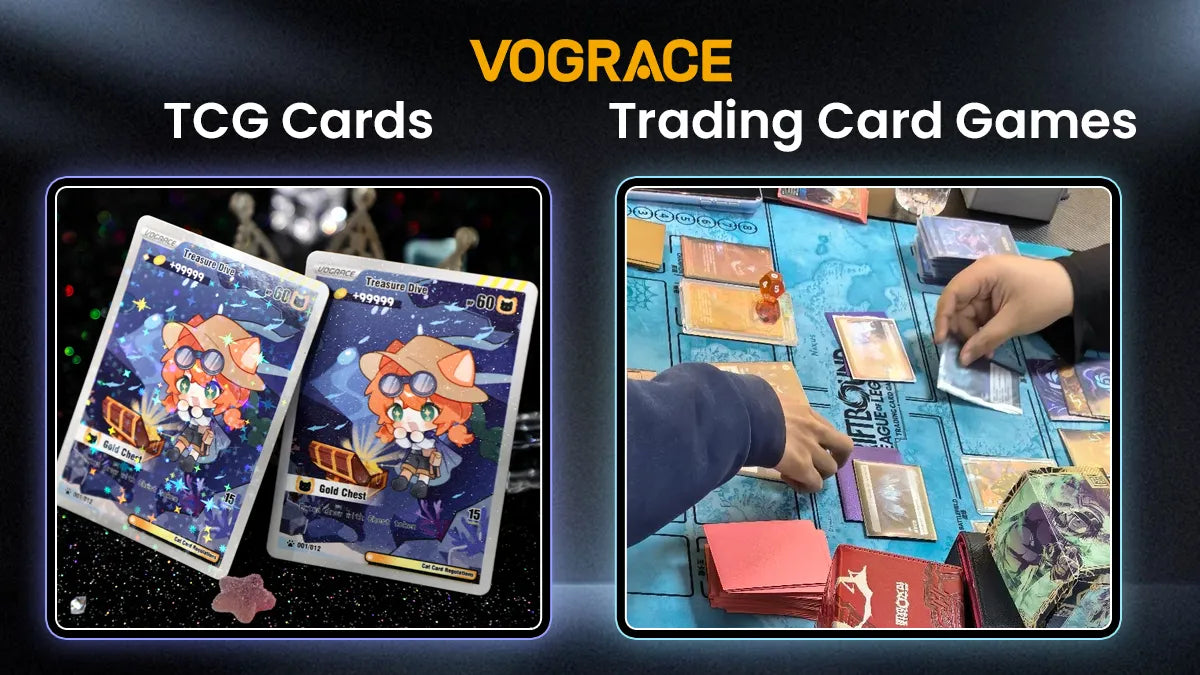
You might've already noticed the craze around Pokémon cards and people talking about trading, market price, mint condition, and whatnot. For a beginner, this can look confusing from the outside, but honestly, the basics are easier to pick up than they seem.
This guide walks you through what TCG cards are, how they work, which are the popular ones, and how to start your own collection today!
What Are TCG Cards?
TCG stands for Trading Card Game. It's the type of game where players use decks made up of individual cards to compete against one another. The cards usually represent a character, an ability, an item, or something else entirely, but every card follows its own set of rules for how it can be used.
TCG cards are not like regular trading cards, in a way. By regular, take something like a sports card, which exists mainly to be collected and admired. TCG cards are built to be played; there are game rules, strategies, and a winner at the end. You can also create custom TCG cards for your own designs or game ideas.
Most TCG cards have a few things in common. There is the usual artwork that shows the character or the object, a card type that tells you what kind of card it is, and abilities or effects that explain what the card does in play. Many cards also show stats such as attack, defense, hit points, etc.
On top of all this, cards carry something called a rarity level, which affects how easy or hard they are to find, which also decides their value; more about it later in the article.
How Trading Card Games Actually Work
Every TCG starts the same way: with a deck.
Players build their deck ahead of time, picking cards that work well together and match a strategy or a theme they want to try. Once the game starts, each player draws a hand of cards from their shuffled deck.
From there, the game moves in turns. On their turn, a player might play new cards, use abilities or effects, or spend resources to activate certain cards. Most TCGs require a specific type of resource, say, like gold, supplies, energy, or mana, before a stronger card can be used.
As the game continues, players interact with each other through their cards. This could mean attacking an opponent's creatures, or defending your own against incoming attacks, or using an ability or an effect to disrupt what the other player is trying to do; there is a lot of strategy involved.
Now comes the winning condition, which decides when the game usually ends. In many TCGs, this means reducing an opponent's hit points/life points to zero. However, a few games use different goals entirely, for example, completing a specific task or running the opponent out of cards.
It's worth knowing that these steps can look a little different depending on the game, because each TCG has its own rulebook. But for a general idea, this is how trading card games work; the basic structure stays similar, but the details are never quite the same.
What Are the Most Popular Trading Card Games?
A few titles remain titans in the industry, and when someone hears the word "TCG," they usually think of these games, collectively known as "The Big Three":
Magic: The Gathering
 Magic: The Gathering is often credited as the game that started the modern TCG format. It offers a wide range of card types and strategies, and countless later titles took inspiration from its mechanics, deck structures, and rules.
Pokémon Trading Card Game

Arguably the most popular TCG out there, the Pokémon Trading Card Game lets players battle using cards based on Pokémon, each with their own attacks, strengths, and weaknesses. It is known for being beginner-friendly while also offering real depth for someone who loves a competition.
Yu-Gi-Oh!
 Another extremely popular TCG, Yu-Gi-Oh! focuses on summoning monsters and casting spells and traps to outplay your opponent. The game is closely tied to its own storyline and characters, which played a huge part in building a loyal fanbase beyond the card game itself.
As mentioned in how TCGs work, each of these three games plays differently, but all of them share the same foundations: build a deck, take turns, and use strategies to outplay your opponent.
Getting Started: A Beginner's Guide to Collecting TCG Cards

Now that you know how the games work, and if you're interested in starting your own journey, the next step is figuring out how to start building your own collection. Not only that, also learn how to take care of it once you have it.
How To Collect TCG Cards
Here are a few common ways to collect TCG cards.
The first one is a booster pack, which gives you a mix of random cards from a set. Opening these packs is where the most fun is at.
If you already know which cards you want, you can simply buy individual singles instead. Cards are also grouped into sets, which are released over time and often bring new mechanics with them.
Some people collect purely out of hobby and to build a display, while others specifically to build card decks they plan to play.
How To Know a Card's Value
Knowing a card's value is extremely important in collecting TCGs, because not all cards are worth the same. Here are a few things that decide a card's value.
● Rarity plays a massive role, since cards that are harder to find usually carry higher value.
● Condition matters a lot more than you think, as a card in mint shape is worth way more than one that is bent or damaged.
● Demand and playability also come into play, since a card that performs well in competitive decks often becomes more sought after.
● Special or limited editions, like alternate art versions, can push prices even higher.
These are the common factors, but there are a lot more aspects that decide a card's value, which is why prices can vary so much across a single set.
Luckily, finding out values is easier than ever. You can instantly check real-time prices on online marketplaces or sold listings.
How To Protect Your TCG Cards
To preserve your card's value or the cards themselves, it's important you know how to protect them.
● Sleeves are the simplest starting point; they keep fingerprints and light scuffs off the card surfaces.
● Binders are great for storing and organizing a large collection, especially if you like being able to flip through your cards easily.
● For your most valuable cards, top loaders or hard card holders offer stronger protection.
Beyond these, it's also important where you store the cards. Store them somewhere dry and away from direct heat, and try to limit how much you handle them.
Frequently Asked Questions
What Is the Difference Between a TCG, a CCG, and an LCG?
A TCG (Trading Card Game) and a CCG (Collectible Card Game) both use randomized packs and are usually treated as the same thing. LCG (Living Card Game) skips randomness and sells a fixed set of cards.
What Is the Best TCG for Beginners?
Pokémon Trading Card Game suits a lot of beginners. The rules are simple, and most players already have an idea about Pokémon. Moreover, there is a large community ready to help new players all the time.
Can I Make My Own TCG?
Yes, many creators make their own trading card games, and you can do it too. You can either make your cards from scratch or order custom Holographic TCG Cards from our site for a rare, professional finish.
Is TCG an Expensive Hobby?
It can be, but it doesn't necessarily have to be. Whether your collection hobby turns expensive or not depends completely on your approach, whether you are collecting casually or going for rare, competitive cards.