How to Make & Sell Stickers Online: A Beginner’s Guide
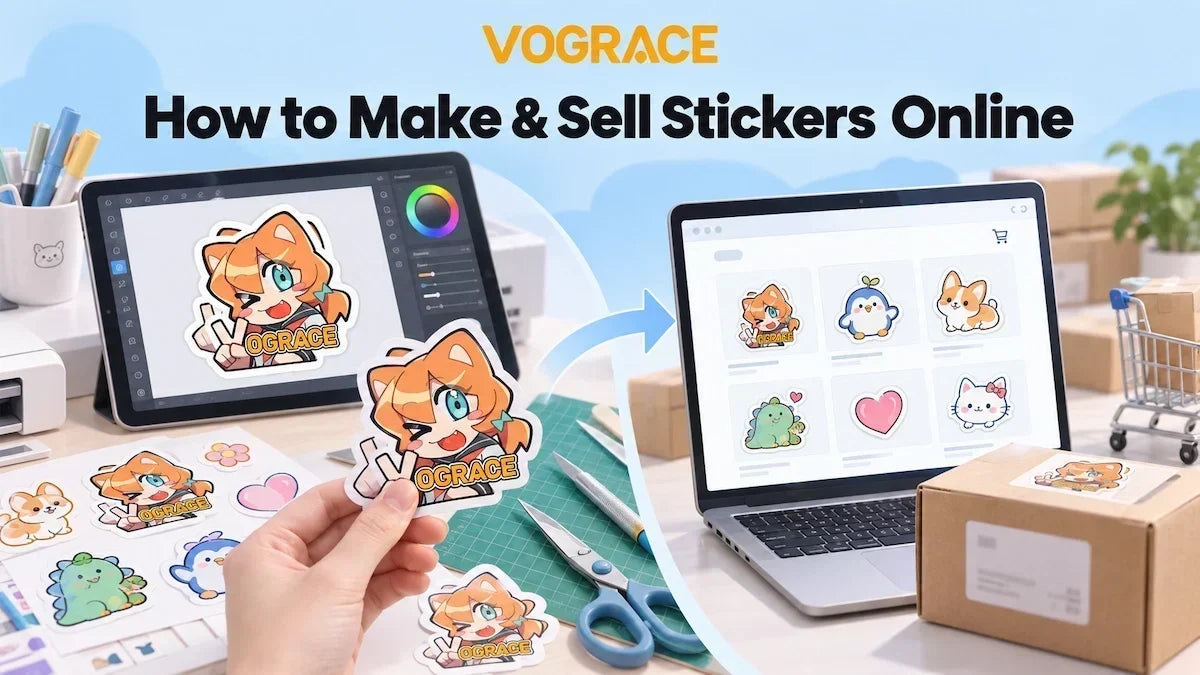
Stickers are one of the easiest ways to turn an illustration, character, logo, or creative idea into a physical product.
They are affordable to test, easy for customers to understand, and flexible enough to sell individually, in packs, at conventions, or through an online store.
But there are really two questions behind starting a sticker business:
How will you make your stickers?
And:
How will you sell them?
You can make stickers at home, order professionally printed custom stickers, or use print on demand and avoid holding inventory altogether. On the selling side, you can choose marketplaces, social media, conventions, local markets, or your own online store.
Here is how the process works.
Part 1: How to Make Stickers
For most beginners, sticker production starts with two options: making them yourself or ordering custom stickers from a manufacturer.
How to Make Stickers at Home
DIY sticker making is a practical way to test ideas and learn how stickers are produced.
A basic setup usually includes:
· Sticker paper or printable vinyl
· A compatible printer
· Scissors, a craft knife, or a cutting machine
· A cutting mat
· Clear laminate if extra protection is needed
· Design software
The basic process is simple:
1. Create Your Design
Use artwork that remains clear at the final sticker size. Fine details and very small text can disappear once printed.
For die-cut designs, a clean outline around the artwork can also make cutting easier.
2. Print Your Stickers
Arrange several designs efficiently on the sheet and use the appropriate print settings for your chosen material.
Let the ink dry before laminating or cutting.
3. Laminate if Needed
A clear laminate can add protection and improve resistance to everyday handling.
Whether you need it depends on the sticker material and intended use.
4. Cut the Stickers
Simple designs can be cut with scissors or a craft knife. A cutting machine is more practical if you want cleaner, repeatable results or need larger quantities.
For the complete DIY process, see our DIY Stickers Guide.

When Does DIY Work Best?
DIY sticker making is useful when you:
· Want to test a few designs
· Only need small quantities
· Enjoy making products yourself
· Want direct control over production
The main limitation is time. Printing, laminating, cutting, checking quality, and maintaining equipment becomes harder to manage as sales grow.
When Custom Sticker Printing Makes More Sense

If you plan to sell stickers regularly, professional custom production can be more practical.
It is especially useful when you need:
· Consistent printing and cutting
· Larger quantities
· Specialty materials
· Repeatable best sellers
· Inventory for conventions or markets
· Less time spent on manual production
Custom manufacturing also gives you access to effects that are difficult to reproduce with a basic home setup.
The Vograce custom stickers includes options such as vinyl, holographic, clear, glitter, sticker sheets, puffy stickers, and other specialty formats.
The best choice depends on the artwork.
A simple illustration may work perfectly as a standard die-cut sticker, while holographic or glitter effects may suit designs created around reflective details.
DIY vs Custom Stickers
|
Factor |
DIY |
Custom Production |
|
Best for |
Small tests and hobbies |
Selling and repeat production |
|
Equipment |
Required |
Production handled externally |
|
Time |
More hands-on |
Less production work |
|
Consistency |
Depends on setup |
Easier to maintain |
|
Finish options |
More limited |
Wider selection |
|
Scaling |
Harder |
Easier |
DIY works well for experiments and small batches.
Custom production becomes more useful when consistency, time, materials, and scale start to matter.
There is also a third option: selling through print on demand without making or stocking stickers first. We will cover that in the selling section.
Part 2: How to Sell Stickers Online
Once the product is ready, the next step is deciding what to sell, how much to charge, where customers will find it, and how orders will be fulfilled.
Decide What Kind of Stickers to Sell
You do not need dozens of designs to launch.
A focused collection is usually easier to photograph, promote, and test.
You could start with:
· Individual die-cut stickers
· Sticker sheets
· Character collections
· Themed sticker packs
· Limited-edition designs
· Stickers bundled with other merch
When choosing designs, ask:
· Is the artwork clear at a small size?
· Does it have a recognizable silhouette?
· Would someone want to display it?
· Does it fit with the rest of the collection?
A few related designs are often more effective than a large catalog of unrelated ideas.
Choose the Right Sticker Format
Different formats work for different types of artwork.
Die-Cut Stickers
Cut around the shape of the artwork. Good for characters, logos, icons, and individual illustrations.
Kiss-Cut Stickers
The sticker is cut while the surrounding backing remains intact, making it easy to handle and peel.
Sticker Sheets
Several smaller designs appear on one sheet. These work well for mini characters, expressions, journaling, and themed sets.
Specialty Stickers
Holographic, glitter, clear, puffy, and other finishes can make a collection more distinctive.
Choose the effect because it supports the artwork, not simply because it looks unusual.
How to Price Stickers
Pricing should start with your own costs.
At a basic level:
Selling Price − Total Selling Cost = Gross Profit
Your costs may include:
· Production
· Packaging
· Shipping materials
· Marketplace or payment fees
· Store expenses
· Discounts
· Advertising
· Replacement orders
Do not base your price only on what another artist charges.
Their production model, audience, fees, and order quantity may be completely different.
Also consider:
· Sticker size
· Material and finish
· Product quality
· Market expectations
· Whether you want room for bundles or promotions
The goal is to find a price that works for both the customer and your business.
Consider Sticker Packs and Bundles

You do not have to sell every sticker individually.
Bundles can increase order value and make a small collection feel more complete.
For example:
· One individual sticker
· A three-sticker set
· A character collection
· A themed pack
· A sticker sheet
· A mixed merch bundle
Just make sure bundle discounts still leave enough margin.
Choose Where to Sell Your Stickers
There is no single best place to sell stickers.
Different channels offer different advantages, and many creators eventually combine several.
Online Marketplaces
Marketplaces can help you reach people who are already searching for products.
Advantages may include:
· Existing buyer traffic
· Search and category discovery
· Familiar checkout
· Easy setup
Possible drawbacks include:
· Strong competition
· Seller or transaction fees
· Marketplace rules
· Less control over branding
Marketplaces can be useful for discovery, especially when you are still building your own audience.
Social Media
Social platforms can help people discover your artwork before they discover your products.
Useful content includes:
· Sketch-to-sticker videos
· Design reveals
· Sticker production
· Packaging orders
· Material comparisons
· Collection launches
· Customer photos
Rather than repeatedly posting “buy my sticker,” show how the artwork becomes a finished product.
Social media often works best as a discovery channel that sends people to the place where you actually take orders.
Conventions and Local Markets
Artist alleys, conventions, craft fairs, and local markets are useful for selling stickers face to face.
Stickers work well in these settings because customers can quickly browse multiple designs and add them to larger merch purchases.
This channel normally requires physical inventory, so custom production is useful for:
· Convention stock
· Bundles
· Immediate pickup
· Limited collections
You can also turn offline customers into online customers by adding your store URL or QR code to packaging, signs, and business cards.
Your Own Online Store
Your own store gives you more control over:
· Branding
· Product presentation
· Pricing
· Promotions
· Collections
· Customer experience
The main challenge is traffic.
Unlike a large marketplace, your own store does not automatically bring shoppers. You need to attract visitors through social media, search, conventions, communities, collaborations, or returning customers.
There is also another question:
Do you need inventory before opening the store?
Not necessarily.
Sell Stickers Without Inventory With Print on Demand

Print on demand changes the traditional workflow.
With physical inventory:
Make → Stock → Sell → Ship
With POD:
List → Customer Orders → Produce → Fulfill
The product is made after someone places an order.
That means you do not necessarily need to choose between printing stickers at home and ordering a custom batch before you begin selling.
For artists who want their own online store without holding inventory, Artiststore provides another option.
Artiststore is a print-on-demand store platform designed for artists and creators. You can create a store, upload artwork, add products, set selling prices, and start promoting your work without purchasing finished inventory first.
When a customer orders, production and fulfillment are handled through the platform.
This model can be useful when you want to:
· Test several designs
· Avoid upfront inventory
· Keep more products available online
· Spend less time packing orders
· Focus more on art and promotion
POD does not replace custom production in every situation.
If you need convention stock, specialty finishes, custom packaging, bundles, or already know a design sells consistently, ordering physical inventory may still make more sense.
Many artists can use both models.
For example:
Test designs with POD
→ Identify best sellers
→ Order proven designs in larger quantities
This reduces the need to guess which products deserve inventory.
Which Sticker Business Model Fits You?
|
Situation |
Practical Starting Option |
|
I want to make products myself |
DIY |
|
I only need a few stickers |
DIY |
|
I need stock for conventions |
Custom production |
|
I want specialty materials |
Custom production |
|
I already know what sells |
Custom production |
|
I want to test demand |
POD or a small custom run |
|
I do not want inventory |
POD |
|
I want many designs online |
POD |
|
I sell online and offline |
Combine POD and custom inventory |
Your model can change as your business grows.
You do not need to commit to one production method forever.
Create Better Sticker Listings
A good listing should make the product easy to understand.
Clearly include:
· Sticker size
· Material
· Finish
· Quantity
· Whether it is an individual sticker or sheet
· Relevant use or care information
Use descriptive titles instead of vague names.
For example:
Cute Black Cat Vinyl Sticker – Original Character Art
is clearer than:
Cute Sticker #4
Keep descriptions natural and useful. Explain what the design is, what the customer receives, and the important physical details without repeating the same keyword in every sentence.
Use Product Photos That Show the Sticker Clearly
Useful product images can include:
1. A clean main image
2. A close-up of the material or finish
3. The sticker held in a hand for scale
4. Several designs shown together
5. A lifestyle image showing the sticker in use
Special finishes may also benefit from short videos.
Holographic, reflective, glitter, and clear materials are often easier to understand when customers can see how they react to light and movement.
Promote Your Stickers
You do not need to turn every post into an advertisement.
One sticker release can generate several pieces of content:
· Initial sketch
· Color choices
· Final artwork
· Printed sample
· Material close-up
· Packaging
· Launch post
· Customer photo
This helps customers connect with the creative process rather than seeing only the finished sales page.
Collections are also easier to promote when they share a clear theme, character, style, or story.
Learn From Your First Sales
Your first launch is also a test.
Pay attention to:
· Which designs get clicks
· Which designs actually sell
· Whether people prefer singles or bundles
· Which materials perform best
· Which products work online versus at events
Use that information to decide what to restock, expand, or discontinue.
A POD design that sells consistently may become a good candidate for custom production.
A stocked design that receives little interest may not need another large order.
Let real customer behavior guide your next collection.
Common Beginner Mistakes
Ordering Too Much Too Early
A low unit cost can be tempting, but unsold inventory still costs money.
Test demand first when possible.
Launching Too Many Designs
A focused collection is easier to manage, promote, and evaluate.
Ignoring the Full Cost of a Sale
Production is only one expense. Remember packaging, platform fees, fulfillment, discounts, and shipping-related costs.
Choosing Materials Only for the Effect
Specialty finishes should improve the artwork, not distract from it.
Depending on One Sales Channel
Marketplace traffic, social algorithms, and event schedules can all change.
Over time, having more than one way for customers to find you makes your business more resilient.
Selling Artwork Without Commercial Rights
Only sell designs you have the right to use commercially.
Copyright, trademark, licensing, and platform policies may apply when using protected characters, logos, artwork, or branding.
A Simple Beginner Workflow
If you want to keep things simple, choose one of three routes.
DIY
Create designs
→ Print at home
→ Cut and test
→ Start selling
→ Improve as demand grows
Custom Production
Create artwork
→ Choose a material
→ Order a sample or small batch
→ List your products
→ Sell online or at events
→ Restock proven designs
Print on Demand
Create artwork
→ Add products to your store
→ Publish
→ Promote
→ Customer orders
→ Product is produced and fulfilled
You can also combine these methods.
A creator may start with DIY, move successful designs into custom production, and use POD to test new ideas without adding more inventory.
Final Thoughts
Making stickers is easy to start.
Selling them successfully requires a little more planning.
DIY is useful for learning and small-scale testing.
Custom production becomes more practical when you need consistency, specialty materials, or larger quantities.
Print on demand gives you another route if you want to sell online without stocking finished products first.
From there, focus on the fundamentals:
Create designs people connect with.
Choose the right production model.
Price using your real costs.
Sell where your audience already spends time.
Make your listings clear.
Show the actual product.
And pay attention to what customers buy.
You do not need a huge catalog to begin.
A few strong designs and a practical way to make and sell them are enough to start.
FAQ
Is Selling Stickers Online Profitable?
It can be. Profit depends on production costs, selling price, platform fees, shipping, marketing expenses, and sales volume.
What Is the Easiest Way to Make Stickers for Beginners?
Sticker paper, a compatible printer, and basic cutting tools are enough for simple DIY tests. Custom production may be easier when you need consistent commercial results.
Is It Better to Make Stickers Yourself or Order Custom Stickers?
DIY works well for small quantities and experimentation. Custom production is more practical when you need consistency, specialty materials, or larger volumes.
Where Can I Sell Stickers?
Common options include online marketplaces, social media, your own online store, conventions, artist alleys, craft fairs, and local markets.
Can I Sell Stickers Without Holding Inventory?
Yes. Print-on-demand services produce products after customers order them, so you do not need to purchase finished inventory in advance.
Should I Order Samples Before Selling Stickers?
It is recommended when possible, especially when testing a new material, size, finish, manufacturer, or color treatment.
How Should I Price My Stickers?
Calculate production, packaging, selling fees, fulfillment, and other relevant costs first. Then consider your product type, market expectations, and target margin.
Can I Sell Stickers With Anime or Game Characters?
Only if you have the appropriate commercial rights or permission. Copyright, trademark, licensing, and platform rules may restrict the commercial use of protected characters and artwork.