15 Best Platforms to Sell Your Art Online in 2026
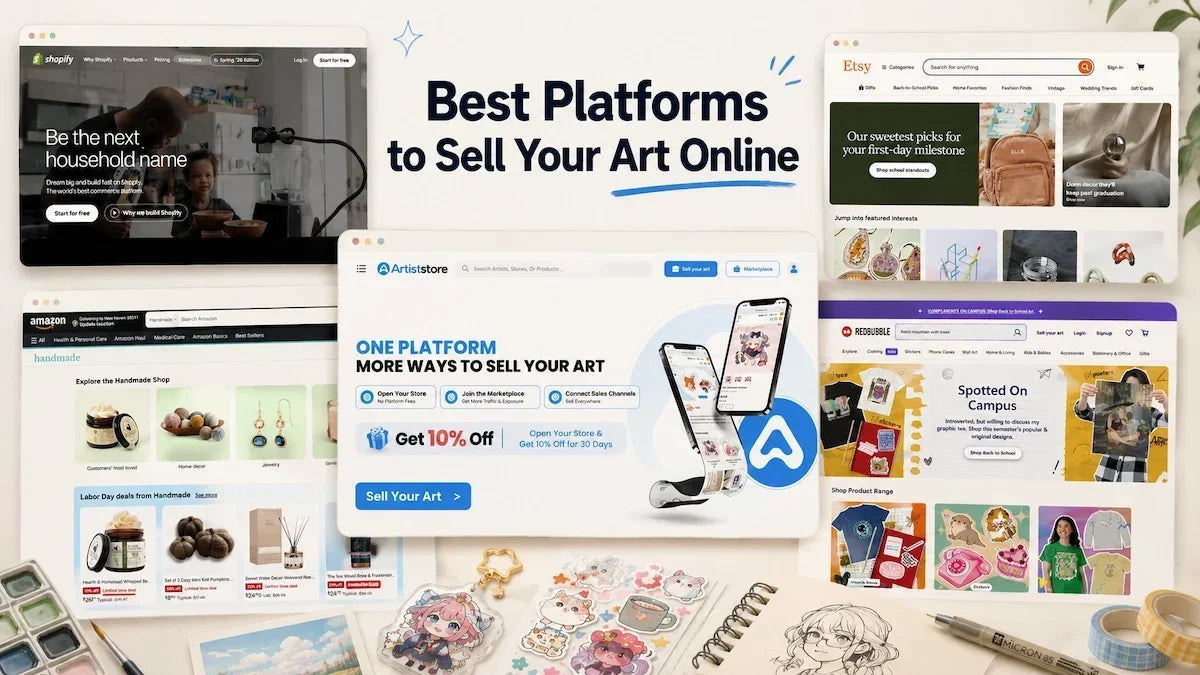
Every artist eventually asks the same question: where should my work actually live online? The honest answer is that no single platform gets everything right. Marketplaces bring built-in shoppers but take a cut of every sale. Your own store gives you far more control but leaves you responsible for finding customers. Print-on-demand platforms remove the manufacturing headache, while curated art marketplaces can put work in front of collectors who are already looking to buy.
Before you commit to one — or a few — here's a straightforward, side-by-side look at 15 of the strongest places artists are selling online in 2026, what each platform does well, where it falls short, and who it genuinely suits.
How the 15 Platforms Compare
Here’s how all 15 platforms compare at a glance, based on our editorial evaluation of cost, audience, control, fulfillment, and overall usefulness to independent artists.
Pricing and platform policies were checked in September 2026. Fees can vary by seller country, payment method, product category, plan, and promotional program, so always confirm current terms before opening a shop.
|
Platform |
Rating |
Pricing Model |
Fees / Commission |
Audience |
Fulfillment |
Best For |
|
1. Shopify |
4.8 |
From $29/mo billed yearly |
No marketplace commission; payment processing starts around 2.9% + $0.30 on Basic in the U.S. |
Bring your own |
Self-managed or via POD/fulfillment apps |
Long-term brand builders |
|
2. Etsy |
4.7 |
Low upfront cost; one-time shop setup fee may apply |
US$0.20 listing + 6.5% transaction fee; payment processing varies by country |
Very large creative-shopping audience |
Mostly self-managed; POD partners allowed |
New sellers who want built-in discovery |
|
3. Amazon Handmade |
4.5 |
Professional plan required; ongoing monthly fee waived for approved Handmade sellers |
15% referral fee or $0.30 minimum per shipped unit |
Mass-market Amazon traffic |
Seller fulfilled or FBA where eligible |
Established makers wanting scale |
|
4. Redbubble |
4.4 |
Free to open a shop |
Artist margin less tier-based account fees; Standard/Premium fees apply when sales occur |
Large POD marketplace |
Fully managed POD |
Passive or secondary merch income |
|
5. Artiststore |
4.4 |
Free — no monthly or platform fees |
0% platform commission; production + shipping costs apply |
Growing creator marketplace + your own audience |
In-house POD production, shipping and after-sales support |
Artists wanting a branded POD store with low upfront risk |
|
6. Fourthwall |
4.3 |
Free — no monthly fee |
0% platform fee on catalog physical products; payment processing applies; 5% on digital products/memberships |
Bring your own audience |
Managed catalog fulfillment; self-sourced products supported |
Creators with an existing community |
|
7. Big Cartel |
4.2 |
Free for 5 products; paid plans from $15/mo |
0% Big Cartel transaction fee; payment processing applies |
Bring your own |
Self-managed; POD integrations available |
Independent artists with a small catalog |
|
8. Fine Art America |
4.1 |
Free core account; optional premium features |
Artist sets markup above base production price |
Large art-and-print audience |
Managed printing, framing, shipping and customer service |
Prints, photography and wall art |
|
9. INPRNT |
4.1 |
Free after artist approval |
Fine-art prints pay 50% of sale price; many other products pay 30% |
Curated art-print audience |
Fully managed printing and shipping |
Illustrators focused on premium prints |
|
10. Saatchi Art |
4.0 |
Free to list |
40% commission on original artwork; artists receive 60% of print profit |
Global collector audience |
Platform-supported shipping workflow for originals; prints managed |
Original fine art and higher-ticket work |
|
11. Artfinder |
3.9 |
Free Starter or paid plans |
50% Starter / 45% Core / 40% Premium commission |
Curated original-art audience |
Artist ships or uses managed shipping where available |
Independent fine artists selling originals |
|
12. Society6 |
3.8 |
No standard monthly storefront fee |
Artist earnings generally 5% or 10% markup depending on product |
Design-led home décor audience |
Fully managed POD |
Existing approved Society6 artists |
|
13. Ko-fi |
3.8 |
Free; optional paid upgrade |
5% on shop sales on free/standard setup; payment processing applies |
Mostly your own followers |
Self-managed shipping for physical products; automatic digital delivery |
Artists selling directly to a community |
|
14. eBay |
3.7 |
Up to 250 zero-insertion-fee listings/month for many sellers |
Final value fee varies by category; art commonly around the low-to-mid teens plus per-order fee |
Huge general marketplace |
Self-managed |
Originals, vintage work and price-flexible inventory |
|
15. ArtPal |
3.5 |
Free basic selling |
0% commission on self-fulfilled original art; POD profit based on markup over base cost |
Smaller art-focused marketplace |
Self-managed originals; POD available |
Beginners testing an extra low-cost channel |
1. Shopify

Shopify isn’t an art marketplace at all. It’s a full ecommerce platform that lets you build and own a branded storefront from the ground up, then connect the fulfillment, print-on-demand, email, analytics, and sales tools that fit your business.
Pros:
· Complete ownership of your storefront design, pricing, brand experience, and customer relationships
· A huge app ecosystem makes it easy to connect POD and fulfillment services
· Scales cleanly from a small artist shop to a serious ecommerce business without changing platforms
Cons:
· No built-in marketplace audience — you have to create your own traffic
· Basic starts at $29/month when billed yearly, before most optional apps or premium themes
· More setup, maintenance, and marketing work than simply listing on a marketplace
Our take: Shopify still earns the top spot for artists who already have some kind of following — social media, past customers, a mailing list, or convention traffic — and want to build a durable brand they fully control.
2. Etsy

Etsy remains one of the most natural marketplaces for artists, illustrators, makers, and merch sellers because its shoppers already arrive expecting creative, personalized, and independently made products.
Pros:
· A very large buyer base actively searching for creative goods
· Easy to start with relatively low upfront cost
· Strong fit for prints, stickers, pins, handmade products, digital downloads, and personalized work
Cons:
· The fee stack is more complicated than it first appears: listing, transaction, payment processing, and sometimes advertising fees
· Competition is intense, so photography, keywords, reviews, and shop presentation matter
· You build your business inside Etsy’s ecosystem rather than owning the full customer relationship
Our take: For artists who have never sold online before, Etsy is still one of the best places to test demand quickly. It gives you real buyer data before you invest heavily in a standalone store.
3. Amazon Handmade
Amazon Handmade gives approved makers access to Amazon’s enormous customer base while separating handmade products from the broader catalog. For artists selling physical goods, it can be a powerful scale channel — but it feels more like retail than an artist portfolio.
Pros:
· Massive customer reach and strong buyer trust
· The normal ongoing Professional selling-plan fee is waived for approved Handmade sellers
· Useful for repeatable physical products that can be listed and fulfilled at scale
Cons:
· Application and product eligibility rules create more friction than Etsy
· Amazon Handmade charges a 15% referral fee or $0.30 minimum per shipped unit
· The product-first experience gives you less room to tell an artist story or build a distinctive visual world
Our take: Best for artists and makers with proven products who want reach and purchasing volume. It is less compelling as a first home for an emerging artist who still needs to develop a brand and audience.
4. Redbubble

Redbubble is a long-running print-on-demand marketplace where artists upload designs and the platform turns them into products, handles production, ships orders, and deals with customers. The appeal is simplicity; the trade-off is margin and control.
Pros:
· Very little operational work after a design is uploaded
· Free to create an account and list work
· Built-in audience already browsing stickers, apparel, wall art, accessories, and giftable designs
Cons:
· Standard and Premium accounts are subject to account fees when they earn sales; current platform fees are a meaningful deduction from artist earnings
· Heavy competition makes organic discovery difficult
· Limited control over the customer experience, packaging, pricing logic, and long-term customer relationship
Our take: Redbubble still makes sense as a secondary channel for designs that can sell repeatedly without extra work. We would treat it as passive distribution rather than the center of an art business.
5. Artiststore

Artiststore is a store-setup and print-on-demand platform built specifically for artists and creators. It combines a branded storefront with built-in production and fulfillment, so you can sell physical merch without buying inventory first.
Pros:
· No monthly, annual, listing, or platform service fees; Artiststore states it takes 0% platform commission
· Built-in product creation tools and 10,000+ customization variants across its catalog
· Production, packaging, global shipping, and after-sales support are handled through its fulfillment system
· You can run your own storefront and also apply to join the Artiststore Marketplace for additional discovery
· Customer payments can go directly to your connected Stripe or PayPal account
Cons:
· It is much newer than Etsy, Amazon, or Redbubble, so its marketplace traffic is still developing
· You still need to create strong designs, storefront branding, and promotion to build reliable sales
· As of September 2026, Shopify is the currently supported external sales-channel integration; additional integrations are still developing
Our take: Artiststore is one of the more interesting choices for illustrators, fandom artists, and merch-focused creators who already have an audience but don’t want monthly ecommerce fees or inventory risk. It works especially well when physical products are a core part of the plan.
6. Fourthwall

Fourthwall is a creator storefront platform built around merch, digital products, memberships, and direct fan support. Like Artiststore, it removes much of the fulfillment work while still giving creators a branded place to sell.
Pros:
· No monthly fee or upfront cost for the standard creator storefront
· Fourthwall charges no additional platform percentage on physical products from its catalog; creators keep the difference after product cost and processing
· Managed manufacturing and shipping for catalog products, while self-sourced products are also supported
· Good mix of shop, memberships, digital products, and audience tools in one place
Cons:
· There is no large open marketplace feeding you customers automatically
· Payment processing still applies, and digital products and memberships carry platform fees
· Best results usually depend on already having viewers, subscribers, followers, or fans to send to the shop
Our take: A strong choice for creators who think of art sales as part of a broader fan business. If you already have an audience on YouTube, Twitch, TikTok, Discord, or Patreon-style communities, Fourthwall is easy to slot into that ecosystem.
7. Big Cartel

Big Cartel has spent years positioning itself as a lightweight ecommerce option for artists, makers, and independent labels. It gives you your own shop without the complexity of a full Shopify setup.
Pros:
· Free Gold plan supports up to five products, which is genuinely useful for small launches
· No Big Cartel transaction fees; you mainly pay your payment processor
· Paid plans remain relatively affordable and add custom domains, digital products, discounts, inventory tools, and more
· Simple interface suits artists who want to sell without learning a large ecommerce system
Cons:
· The free plan becomes restrictive very quickly if you have a growing catalog
· No built-in marketplace audience
· Fewer apps, integrations, and advanced ecommerce features than Shopify
Our take: Big Cartel is a good middle ground for independent artists who want their own storefront but only sell a focused range of prints, zines, pins, shirts, or small merch drops.
8. Fine Art America

Fine Art America is built around reproductions, wall art, photography, and print-on-demand products. Artists upload work, set a markup above the platform’s base price, and Fine Art America handles the production side of the order.
Pros:
· Free core account with optional premium features
· Strong specialization in art prints, framed work, canvas, metal, acrylic, posters, and related wall art
· Artists choose their own markup above the platform’s base price
· Printing, framing, packaging, shipping, payment processing, and customer service are handled for you
Cons:
· The storefront experience is less brand-controlled than running your own ecommerce site
· Profit depends heavily on the markup you can sustain above the base product cost
· The platform is a better fit for wall art than for creator merch such as charms, pins, or fandom collectibles
Our take: A very practical choice for photographers, painters, and illustrators whose strongest products are prints and wall art. It is less useful if your business is centered on custom merch categories.
9. INPRNT

INPRNT is a curated print platform with a strong reputation among illustrators and digital artists. It focuses heavily on high-quality reproductions and gives approved artists a simple way to sell without handling fulfillment.
Pros:
· Fine-art prints currently pay artists 50% of the sale price, with many other product categories paying 30%
· Production, shipping, and customer service are handled by INPRNT
· Audience is more art-focused than a general merchandise marketplace
· Strong fit for polished illustration, fan-adjacent original work, concept art, and portfolio pieces
Cons:
· Artists must be approved before selling
· Product range is narrower than broad POD platforms
· You have limited control over storefront functionality and the customer relationship
Our take: INPRNT is one of the better specialized options for artists whose work sells best as premium prints. The quality-first positioning can be more valuable than having hundreds of product types.
10. Saatchi Art

Saatchi Art is a global online art marketplace aimed more at collectors than merch shoppers. The platform is centered on original art, with a more gallery-like environment than Etsy, Redbubble, or Amazon Handmade.
Pros:
· Recognizable art-market brand and access to international collectors
· Free to list original work
· Strong presentation for paintings, drawings, photography, sculpture, and higher-ticket pieces
· The platform provides selling and shipping guidance designed around original artwork
Cons:
· Saatchi Art takes a 40% commission on original artwork
· Competition is global and the marketplace is selective in what gets meaningful visibility
· Not designed for small-ticket creator merch or casual product drops
Our take: Saatchi Art is best for artists who are selling original work at prices where a collector-focused audience matters more than maximizing the percentage kept from each sale.
11. Artfinder

Artfinder is a curated marketplace for independent artists selling original artwork. Sellers apply before opening a shop, and the platform uses tiered plans that trade lower commissions for higher monthly fees and more features.
Pros:
· Art-focused buyer environment rather than a general marketplace
· Free Starter plan is now available, lowering the barrier to test the platform
· Optional managed shipping and strong tools for original-art sellers
· Paid tiers improve visibility, listing limits, and commission rates
Cons:
· Commission is high: currently 50% on Starter, 45% on Core, and 40% on Premium
· Application approval is required
· Paid plans only make sense when your sales volume can justify the monthly cost
Our take: Artfinder is worth considering for serious original-art sellers who want a curated marketplace and are comfortable trading a significant commission for access to collectors and platform support.
12. Society6

Society6 is a design-led print-on-demand marketplace best known for wall art and home décor. It still handles manufacturing, shipping, and customer service, but the artist program is more curated than it used to be.
Pros:
· Hands-off POD fulfillment across art and home categories
· A recognizable design-shopping audience
· Artists can focus on uploading artwork rather than running production and logistics
Cons:
· Current artist earnings are standardized: many products use a 5% markup, while selected wall-art products use 10%
· New designs go through review before publication
· At the time of this review, Society6’s help center says new artist applications are temporarily closed, so it is not an immediately available option for every new seller
Our take: For artists who already have an approved account, Society6 can still function as a passive distribution channel. For someone choosing a new platform today, the current application restrictions make it harder to recommend higher on the list.
13. Ko-fi

Ko-fi started as a simple tipping tool but has grown into a compact creator business platform with a shop, commissions, memberships, digital downloads, and supporter tools. It works more like a direct-to-fan page than an open marketplace.
Pros:
· Free to start with no listing fee for the shop
· Sell physical products, digital downloads, and commissions from the same creator page
· Payments go directly to your connected PayPal or Stripe account
· Especially convenient if followers already use Ko-fi to support your work
Cons:
· The standard shop fee is 5% on sales, plus normal payment processing
· Little built-in shopper discovery compared with Etsy or major marketplaces
· Physical shipping is your responsibility
Our take: Ko-fi is excellent for artists who already have a small but engaged community and want a simple place to turn followers into customers without building a full ecommerce site.
14. eBay

eBay is not an art-first marketplace, but its enormous general audience, fixed-price listings, auctions, and broad product categories make it useful for certain types of art inventory.
Pros:
· Huge buyer base and mature marketplace infrastructure
· Auction format can work well for rare, collectible, signed, or one-off pieces
· Many sellers receive up to 250 zero-insertion-fee listings per month
· Good fit for older stock, vintage prints, collectibles, and items with price-discovery value
Cons:
· Final value fees vary by category and can be significant; most art categories sit around the low-to-mid teens before special conditions
· The bargain-and-auction atmosphere can work against premium positioning
· You handle fulfillment and compete beside every other type of product
Our take: eBay is useful as a tactical sales channel, especially for collectible or price-sensitive inventory. We would not make it the main home of a premium artist brand.
15. ArtPal

ArtPal is a low-barrier art marketplace that lets artists list original work and also offers print-on-demand options. Its biggest attraction is cost: you can start without the subscription and commission burden found on many larger platforms.
Pros:
· Free basic entry with no listing fee
· Self-fulfilled original art can be sold without an ArtPal commission
· Print-on-demand options give artists a way to offer reproductions without managing production
· No exclusivity requirement, so it is easy to use as an extra channel
Cons:
· Much smaller buyer ecosystem than Etsy, Amazon, or the larger specialist art marketplaces
· The platform experience and discovery tools feel more limited than newer ecommerce options
· Free access does not guarantee meaningful traffic, so sellers may still need to promote externally
Our take: ArtPal remains a low-risk place to test listings or add another distribution channel, but most artists building consistent sales will probably want it to sit alongside — not replace — a stronger primary platform.
Conclusion
There’s no single “best” platform here — only the best fit for what you sell and how you want to run your business. If you are testing whether your work sells at all, Etsy gives you strong built-in discovery, while ArtPal and Big Cartel offer lower-cost ways to get started. If you already have a following and want more control, Shopify is still the most flexible long-term option, while Artiststore and Fourthwall remove much of the inventory and fulfillment burden for creators focused on physical merch.
For premium prints, INPRNT and Fine Art America are more specialized. For original fine art, Saatchi Art and Artfinder put you closer to collector-style buyers. Redbubble and Society6 are better treated as hands-off secondary channels, while Amazon Handmade and eBay are useful when scale, search volume, or broad retail reach matters more than having a highly curated artist brand.
In practice, many successful artists end up combining two or three platforms: one marketplace for discovery, one branded storefront they control, and one fulfillment channel that handles production while they keep creating. The right mix gives you reach without making your entire business dependent on a single platform’s algorithm, fees, or policies.